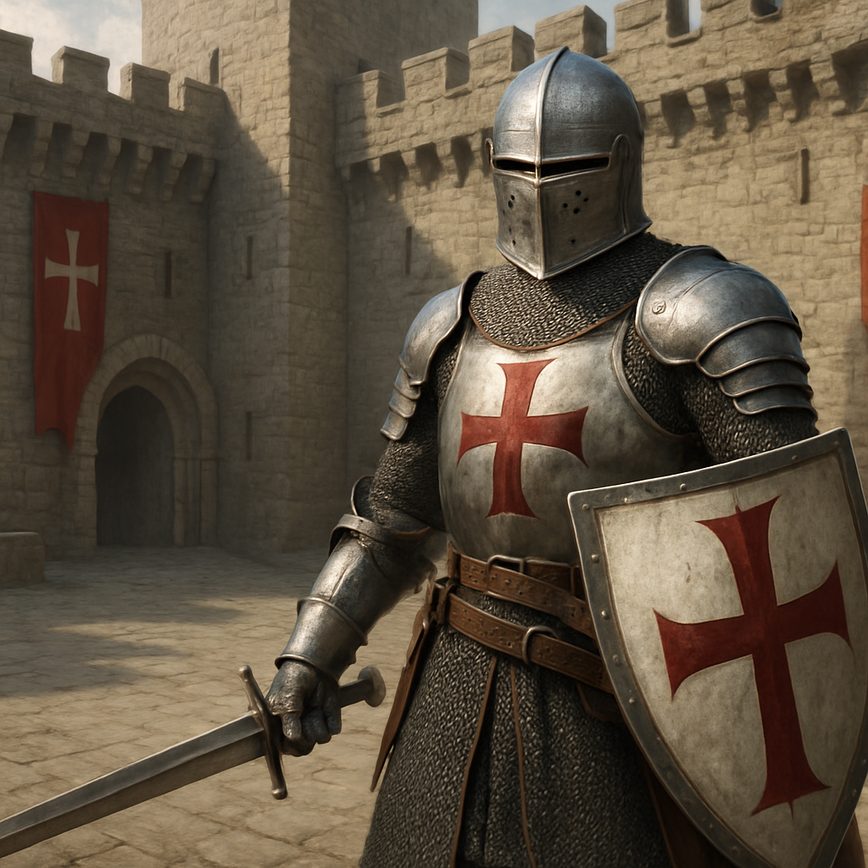
Historical Background of the Knights Templar
The Knights Templar history began in the early 12th century, during a turbulent period marked by the Crusades. Founded circa 1119, the order was established by a group of French knights under the leadership of Hugues de Payens. Their primary mission was to protect Christian pilgrims traveling to the Holy Land following the First Crusade’s success in capturing Jerusalem. This mission reflected the broader purpose of medieval knights during the Crusades: to defend Christendom and secure its territories from hostile forces.
Initially known as the Poor Fellow-Soldiers of Christ and of the Temple of Solomon, the Knights Templar quickly gained recognition and support from the Catholic Church. Their distinctive white mantles adorned with a red cross symbolized purity and martyrdom. The order received formal ecclesiastical endorsement from Pope Innocent II in 1139, granting them significant privileges such as exemption from local laws and direct subordination to the pope alone. This ecclesiastical backing was crucial for the rise of the Knights Templar as both a military and religious institution.
Over time, the Templars evolved beyond their initial role of guarding pilgrims. They became a powerful military force, participating in various Crusades campaigns and securing key strongholds in the Holy Land. Their prowess on the battlefield and strict discipline earned them a legendary status among other medieval knights. Additionally, the Knights Templar established a sophisticated network of fortifications and commanderies across Europe and the Levant, which helped support their operations and expand their influence.
Beyond their military achievements, the Templars were early pioneers in financial innovation, developing a system resembling modern banking to fund their endeavors and credit transactions for pilgrims and noble patrons. Their wealth and influence grew substantially during the Crusades, making the Knights Templar one of the most formidable organizations of the medieval period. Their rise from humble beginnings to a dominant force in both military and economic spheres highlights the complexity and significance of Knights Templar history within the broader context of Crusades and medieval knighthood.
Origins and Formation
The origins of the Knights Templar trace back to the early 12th century during the era of the Crusades. Founded around 1119 AD, the Templar origins lie in the efforts of a small group of founding knights who sought to protect Christian pilgrims traveling to the Holy Land. These knights, initially a modest brotherhood, were soon recognized for their dedication and bravery. Their establishment was driven by the need to defend the routes to Jerusalem and to support the broader efforts of the Crusader orders in securing Christian presence in the region.
The founding knights were primarily French nobles who committed themselves to a monastic lifestyle coupled with martial discipline, creating a unique hybrid order. This blend of religious devotion and military prowess set the Knights Templar apart from other Crusader orders of the time. Their initial missions in the Holy Land focused on safeguarding pilgrims from bandits and hostile forces while establishing strategic fortifications. This dual role of warrior and guardian quickly earned them royal and papal support, enabling the order to grow rapidly in influence and resources.
Thus, the Knights Templar emerged as a cornerstone among Crusader orders, embodying both the spiritual and military zeal of their era. Their founding was a direct response to the volatile conditions in the Holy Land, and their early missions laid the groundwork for their transformation into one of the most powerful and respected military orders in medieval history.
Role During the Crusades
The Knights Templar played a pivotal role during the Crusades, establishing themselves as one of the most formidable medieval military orders. Founded to protect Christian pilgrims traveling to the Holy Land, their military role quickly expanded into active participation in the holy wars. The Crusades presented a unique opportunity for the Templars to demonstrate their martial prowess and strategic acumen on the battlefield.
Throughout the various Crusades, the Templars distinguished themselves not only as fierce warriors but also as highly disciplined fighters who combined religious zeal with effective combat techniques. Their commitment to the cause of reclaiming and defending the Holy Land made them an indispensable force, often taking the vanguard in battles and sieges. Their skill in fortification, battlefield tactics, and cavalry maneuvers contributed significantly to the successes of the Crusading armies.
As one of the earliest and most influential medieval military orders, the Templars established a network of fortresses and commanderies that secured critical supply lines and strategic points, reinforcing Christian presence in contested regions. Their unique blend of monastic dedication and martial efficiency made them a symbol of the Crusading spirit, inspiring other orders and nobility alike.
Ultimately, the Knights Templar’s military achievements during the Crusades solidified their status and power, leaving a lasting legacy in the history of these holy wars. Their disciplined approach to warfare and unwavering devotion to their mission exemplify the complex intersections of faith and military duty that defined the era.
The Trial: Accusations and Proceedings
The Knights Templar trial stands as one of the most infamous and complex legal proceedings of the medieval era. Initiated in 1307, the Knights Templar faced a series of grave accusations that would ultimately lead to the dissolution of this powerful military and religious order. Central to these events were the political and religious dynamics of the time, especially the ambitions of King Philip IV of France and the involvement of the Papal inquisition.
The trial began when King Philip IV, heavily indebted to the Templars, sought to curb their influence and erase his financial obligations. To achieve this, he orchestrated a campaign against the order, accusing them of heresy, blasphemy, idolatry, and a range of other serious crimes. Among the most startling allegations were claims that the Templars engaged in secret rituals that involved renouncing Christ, spitting on the cross, and worshiping a mysterious figure called Baphomet.
These Templar accusations were not only political but also deeply entwined with religious fears. The Papal inquisition, an institution created to root out heresy, was tasked with investigating the charges. However, it operated under immense pressure from King Philip IV, whose influence over Pope Clement V helped shape the course and severity of the investigation. Despite the Templars’ insistence on their innocence, many knights were tortured into confessing crimes they likely did not commit.
Historically, the Knights Templar had been revered as protectors of Christendom, particularly during the Crusades. However, by the early 14th century, their vast wealth and autonomy had become a source of envy and suspicion. King Philip IV’s determination to diminish the order’s power was as much about controlling their resources as it was about addressing alleged moral failings.
The proceedings culminated in a series of trials held across various European kingdoms, heavily influenced by the French crown. The Papal inquisition’s involvement lent an appearance of ecclesiastical authority to what was essentially a politically motivated purge. The Knights Templar trial thus serves as a potent example of how legal processes in medieval Europe were often manipulated by both secular and religious powers to serve their own ends.
–>Charges and Allegations
During the infamous trial of the Knights Templar, a series of grave accusations were leveled against the order, centering primarily on charges of heresy and corruption. The Templar charges included allegations of blasphemy, secret rituals, and behaviors deemed morally and religiously unacceptable by the Church and its inquisitors. Among the heresy accusations were claims that the knights denied Christ, spat on the cross, and worshipped idols in secret ceremonies, which painted a picture of profound spiritual betrayal.
Moreover, the Templars were accused of engaging in corrupt practices that not only undermined their sacred mission but also threatened the social and religious fabric of medieval Christendom. The secret rituals, often described as bizarre and scandalous, were used to justify the harsh treatment and eventual dismantling of the order. These allegations, though widely debated and in many cases extracted under duress, were pivotal in turning public and ecclesiastical opinion against the Templars, leading to their tragic downfall.
Ultimately, these charges and allegations framed the Knights Templar not only as religious heretics but also as a dangerous and subversive force, which played a decisive role in the dramatic and contentious trial that marked the end of one of history’s most powerful and mysterious military orders.
Key Figures in the Trial
The trial of the Knights Templar was orchestrated and presided over by several pivotal figures whose influence shaped the course of this historic event. At the forefront was King Philip IV of France, whose ambition and desire for wealth played a crucial role in initiating the arrests and charges against the Templars. Philip IV saw the powerful order as a threat to his authority and a convenient target to ease his financial burdens.
Pope Clement V, despite his initial support for the Templars, ultimately succumbed to pressure from King Philip IV. As the head of the Catholic Church, Clement V authorized and oversaw the trials, balancing between protecting the Church’s interests and appeasing the French monarchy. His role was essential in legitimizing the proceedings and handing down papal judgments.
Jacques de Molay, the last Grand Master of the Knights Templar, was one of the key figures at the heart of the trial. He steadfastly maintained the innocence of the order throughout the brutal interrogations and trials, symbolizing the resistance of the Templars against the charges of heresy and corruption. His eventual execution marked the tragic end of the order.
Inquisitors appointed by the Church played a critical role in the investigation and interrogation processes. They were responsible for extracting confessions and gathering evidence, often through severe methods, to build the case against the Templars. Their involvement ensured that the trial served both religious and political objectives.
Legal Processes and Interrogations
The medieval trial of the Knights Templar was marked by rigorous legal processes and harsh interrogation techniques, reflective of the inquisition methods of the time. These trials were not merely judicial proceedings but were designed as tools to extract confessions, often under intense pressure. The accused knights were subjected to prolonged questioning sessions where the authority wielded significant control over the narrative and outcome.
Interrogations commonly involved psychological intimidation coupled with the looming threat of torture. Techniques were systematic and brutal, with the objective to break the resolve of the knights to secure confessions. Instruments of torture, such as the rack and the strappado, were frequently employed. These methods were legally sanctioned within the framework of the medieval trial system, despite their severity. Torture was seen as a necessary step to reveal what inquisitors considered the truth about alleged heresies and conspiracies.
Confessions obtained during these trials were pivotal in condemning the Templars, even though many were made under duress and later retracted. The use of torture blurred the line between voluntary admission and forced compliance. This created a controversial legacy surrounding the legitimacy of the confessions and the fairness of the proceedings. Ultimately, the trial of the Knights Templar exemplifies how medieval legal processes intertwined with ruthless interrogation to achieve predetermined outcomes.
Aftermath and Legacy of the Knights Templar Trial
The trial of the Knights Templar marked a profound turning point in medieval history, culminating in the eventual dissolution of the order. Following the intense investigations and coercive interrogations, the Templar dissolution was officially enacted by Pope Clement V in 1312 through the papal bull Vox in excelso. This decree formally disbanded the order, transferring many of its vast properties and wealth to the Knights Hospitaller or other authorities, though in many regions, such transfers were contested and complicated. The trial and subsequent dissolution effectively erased the Templars as a political and military power, but their legacy would endure far beyond their official end.
The historical impact of the Knights Templar’s trial is multifaceted. Politically, it highlighted the rising power of monarchs such as King Philip IV of France, who sought to consolidate their authority and wealth at the expense of influential institutions like the Templars. The trial also exposed the vulnerability of even the most revered orders to the shifting tides of papal and royal politics. Culturally, the dramatic nature of their fall—marked by accusations of heresy, secret rituals, and betrayal—has sparked centuries of fascination, myth-making, and conspiracy theories that continue to captivate historians, writers, and popular culture alike.
From a modern perspective, the Templar trial invites ongoing scholarly debate about justice, power, and historiography. Many historians consider the proceedings to have been highly politicized and based on dubious evidence, reflecting the complex interplay of faith, power, and fear in medieval Europe. The enduring cultural legacy of the Templars is evident in their frequent portrayal in literature, films, and even video games, where they symbolize mystery, chivalry, and hidden knowledge. Moreover, contemporary interest in Templar history has sparked renewed archaeological and archival research, shedding light on the true nature of the order and its role in medieval society.
In sum, the aftermath of the Knights Templar trial resonates through history as a tale of dramatic downfall, legal intrigue, and mythological ascent. Their dissolution marked the end of a storied medieval institution, yet their legacy persists powerfully, illustrating the enduring cultural and historical impact of one of history’s most enigmatic orders.
Dissolution and Punishments
After the conclusion of the trial, the order of the Knights Templar was officially disbanded by Pope Clement V through the papal bull Vox in excelso in 1312. This marked the end of the once-powerful military and religious order, stripping it of its influence and titles. Many Templar members faced severe punishments; a number of them were executed, often accused of heresy and other alleged crimes as part of the trial’s outcomes. The most infamous of these executions was the burning at the stake of the last Grand Master, Jacques de Molay, in 1314.
Beyond the personal fates of the knights, the properties and wealth amassed by the order over decades were seized by the Church and secular rulers. In many regions, the vast estates, castles, and financial resources previously controlled by the Templars were confiscated and redistributed, often to rival orders such as the Knights Hospitaller. The confiscation represented a significant transfer of power and wealth, effectively erasing the Templar’s presence from European political and economic life.
Despite the harsh punishments and property confiscation, some former Templars found ways to integrate into other orders or secular roles. However, the dissolution of the Knights Templar marked a tragic and dramatic end to a once formidable order, with executions and expropriations underscoring the gravity of the charges and the power struggles that sealed their fate.
Influence on Popular Culture and Conspiracy Theories
The trial of the Knights Templar has had a lasting impact on popular culture, fueling a wide array of Templar myths that persist to this day. The dramatic downfall of the order—from their arrest and torture to their dissolution—provided fertile ground for stories that portray the Templars as guardians of secret knowledge and ancient relics. These legends have evolved over centuries, blending historical facts with imaginative interpretations, thus giving rise to a rich tapestry of modern conspiracy theories.
In popular culture, the Knights Templar are often depicted as a powerful secret society whose influence extends into the present. This concept has been popularized through books, movies, and video games, where the Templars are portrayed as mysterious and enigmatic figures entangled in vast conspiracies. The trial itself, seen as a dramatic betrayal, is frequently referenced as the moment when their true power was forcibly concealed by crown and church authorities. These narratives feed into wider ideas about secret societies and hidden agendas, capturing the public imagination and creating a legacy far beyond historical reality.
The enduring fascination with the Templars’ trial has led to a variety of modern conspiracy theories that claim the order survived in secret or passed on crucial knowledge to other groups. Whether it’s theories about lost treasures, sacred artifacts, or covert influence in global events, these stories continue to thrive, demonstrating how the trial’s impact goes beyond history into the realm of myth and legend.

I’ve always been fascinated by how societies and organizations shape history and everyday life. Writing about the interplay between cultural movements and institutional structures lets me explore the stories that connect past and present. I love digging into archives and sharing insights that help readers understand our collective journey.