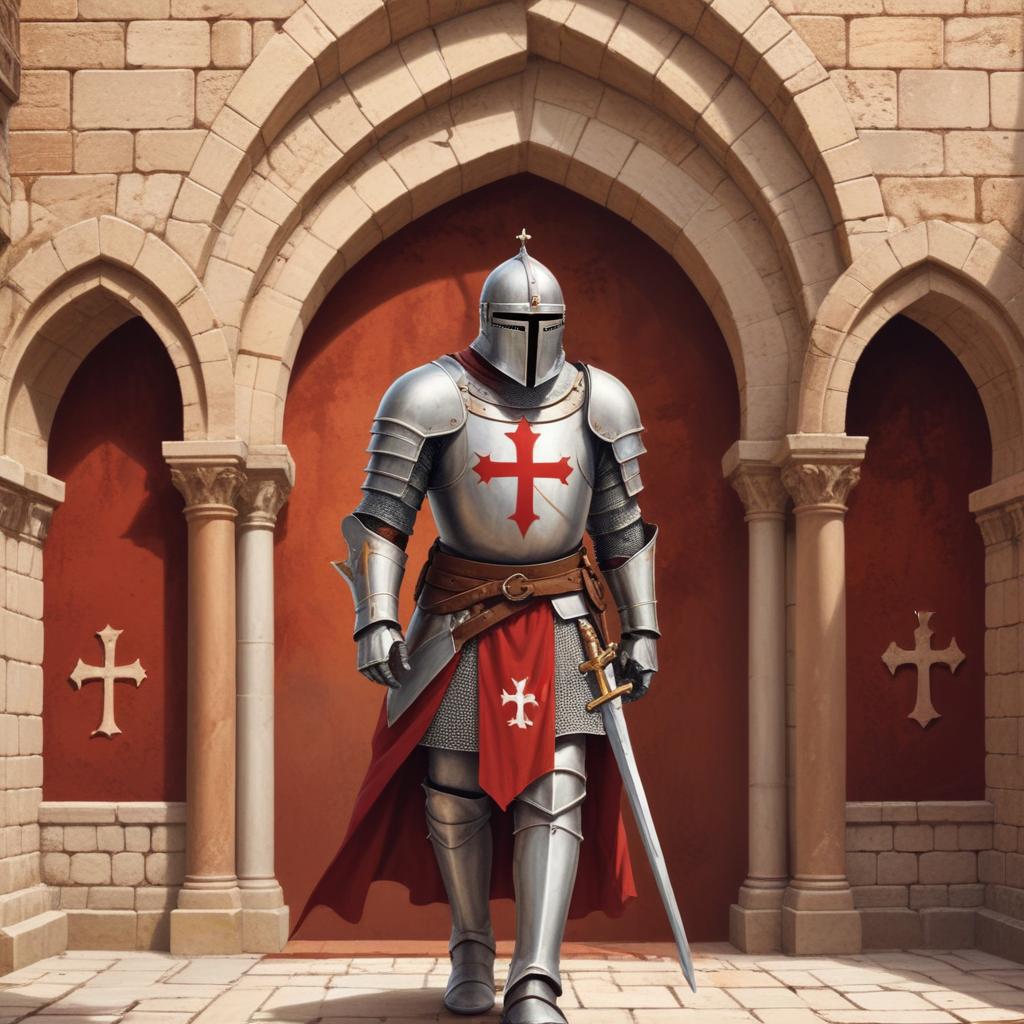
Historical Background of the Knights Templar in Jerusalem
The Knights Templar history begins in the aftermath of the First Crusade, a major military expedition that sought to reclaim Jerusalem and the Holy Land from Muslim control. Founded around 1119, the order was originally established to protect Christian pilgrims traveling to Jerusalem, which had been newly captured during the Crusades. The origins of the Templars trace back to a small group of knights who committed themselves to a religious and military life, with strong backing from the Catholic Church and European nobility.
The arrival of the Knights Templar in Jerusalem marked a significant milestone in both religious and military history. The order’s official recognition came in 1129 at the Council of Troyes, which granted them the status of a religious-military order dedicated to defending Christian interests in the Holy Land. The Crusades created a turbulent environment in Jerusalem, where Christian, Muslim, and Jewish forces vied for control. Here, the Templars developed into a powerful military force, establishing fortifications and playing a crucial role in defending the city and surrounding territories.
The early years of the Knights Templar were marked by rapid growth and the establishment of numerous commanderies and strongholds across Jerusalem and beyond. Key historical milestones include their involvement in defending the Kingdom of Jerusalem, their participation in major battles such as the Siege of Ascalon, and their eventual expansion across Europe as a wealthy and influential order. The Templars’ unique combination of monastic rule and martial prowess distinguished them from other knightly orders.
Throughout the Crusades, the Knights Templar history is intertwined with the larger struggle for control of Jerusalem, symbolizing the blending of religious devotion and military discipline. Their founding origins as protectors of pilgrims evolved into a lasting legacy of chivalry and sacrifice in the Holy Land. By understanding these early historical developments, one gains deeper insight into the enduring mystique and significance of the Knights Templar’s role in Jerusalem during the Crusades.
Formation and Purpose
The formation of the Knights Templar was deeply rooted in the turbulent era of the Crusades, specifically to protect Christian pilgrims traveling to Jerusalem. Founded in the early 12th century, the Templar formation emerged as a response to the pressing need for a dedicated force to safeguard these vulnerable travelers from various threats along the route. Established initially as a monastic order, the Knights Templar evolved into a religious military order that combined strict religious devotion with martial prowess.
The mission of the Knights Templar was twofold: to defend the newly established Christian territories in the Holy Land and to ensure safe passage for pilgrims visiting sacred sites in Jerusalem. This dual purpose distinguished the Templars from other knightly orders at the time. Their commitment to both spiritual and military duties reflected their unique role in the Crusader states, where the balance between faith and warfare was paramount.
Initially, the Templars operated under the guidance of their founder, Hugues de Payens, and quickly gained recognition and support from the Church. Their religious vows and military discipline allowed them to become a formidable force in Jerusalem. The Templars’ early roles involved guarding key fortifications, escorting pilgrims, and participating in battles to defend the Crusader territories. Together, these responsibilities established the foundation for the Knights Templar’s long-lasting influence in both religious and military spheres.
Role in the Crusades
The Knights Templar played a crucial role in the Crusades, particularly through their involvement in key military campaigns and the defense of Jerusalem. Established initially to protect Christian pilgrims traveling to the Holy Land, their responsibilities soon expanded into more direct military engagement. Their disciplined and highly trained knights were instrumental in many battles, providing both frontline combat and strategic leadership.
Their military prowess and dedication made them an elite fighting force in the Crusader states. The Knights Templar were responsible for manning fortifications and securing important routes and strongholds, acting as a formidable bulwark against Muslim forces aiming to reclaim Jerusalem. Their activities in Jerusalem not only included active defense but also involved organizing and executing offensive operations to protect and expand Christian holdings in the region.
Moreover, the Templars’ strategic contributions went beyond battlefield engagements. They established a network of castles, training camps, and supply bases that supported ongoing military campaigns. Their financial acumen and extensive resources also allowed them to sustain prolonged warfare and maintain a robust presence in Jerusalem. This combination of martial skill and strategic infrastructure significantly influenced the course of the Crusades and the defense of the Holy City.
In summary, the Crusades involvement of the Knights Templar was marked by their dedication to both military campaigns and the defense of Jerusalem, cementing their legacy as one of the most effective and enduring military orders of the medieval period.
The Influence and Contributions of the Knights Templar in Jerusalem
The Knights Templar left an indelible mark on Jerusalem, influencing its society, economy, and architectural heritage in profound ways. Their presence at the Temple Mount, the site which held immense religious and strategic importance, was central to their efforts in shaping the city’s landscape and functioning.
On a societal level, the Knights Templar were more than just warriors; they acted as protectors and administrators, helping to stabilize and govern Jerusalem during volatile times. Their disciplined order and strict codes of conduct fostered a sense of security for pilgrims and residents alike, which contributed to social cohesion in a diverse and often tumultuous city.
Economically, the Templars revolutionized the financial system not only locally but across Europe and the Holy Land. Establishing one of medieval Europe’s first robust banking networks, they provided financial services such as safekeeping of valuables and issuing letters of credit, which allowed pilgrims and nobles to travel and trade more securely. These innovations bolstered Jerusalem’s economy by ensuring more reliable commerce and facilitating the flow of goods, money, and people.
Their architectural legacy is also deeply ingrained in Jerusalem’s historical fabric. The Knights Templar constructed impressive fortifications, churches, and other buildings that combined both military functionality and gothic artistry. Their headquarters near the Temple Mount, which inspired the name “Templar,” became emblematic of their presence and influence. Many of their structures showcased advanced engineering techniques and design aesthetics that influenced subsequent architecture in the region.
In summary, the Knights Templar’s contributions to Jerusalem extended beyond their military role. Their involvement in the management of the Temple Mount, innovation in financial systems, and enduring architectural creations collectively shaped Jerusalem’s development during the Crusader period, leaving a legacy that continues to be studied and admired today.
Control of the Temple Mount and Religious Significance
The Knights Templar established their headquarters on the Temple Mount, a site of profound religious importance that shaped both their identity and Jerusalem’s spiritual landscape. By administering control over the Temple Mount, the Templars positioned themselves at a pivotal location linked to the sacred history of the city. Their presence symbolized a union of military prowess and religious devotion, as the Temple Mount was revered by multiple faiths and had deep historical significance as the site of the ancient Jewish Temples.
This control allowed the Knights Templar not only to safeguard a vital religious and strategic landmark but also to influence the spiritual atmosphere of Jerusalem. Their role went beyond military administration; as custodians of such a significant holy site, they contributed to the preservation and sanctity of the Temple Mount. Their activities there reinforced Jerusalem as a center of religious pilgrimage and power during the Crusader period, embedding the Templars deeply into the city’s religious fabric.
The Templars’ governance of the Temple Mount underscored their unique position in the medieval world as warrior monks devoted to the defense of Christianity’s most sacred sites. This dual role helped define the spiritual landscape of Jerusalem, intertwining their legacy with the religious history of the city. Through their stewardship, the Temple Mount became a symbol of both faith and fortitude, marking the Knights Templar as pivotal figures in the ongoing narrative of Jerusalem’s religious importance.
Financial and Economic Roles
The Knights Templar played a pioneering role in the development of an early banking system during the Crusades. As their influence expanded, they established a network of financial services that allowed Crusaders and pilgrims to deposit funds at one location and withdraw them securely at another. This innovative system greatly reduced the risks associated with carrying large sums of money across dangerous territories, enhancing the safety and efficiency of fund transfers throughout the region.
Beyond safeguarding wealth, the Knights Templar were instrumental in funding Crusader activities. Their wealth, accumulated through generous donations, property acquisitions, and business ventures, provided the financial backbone for many military campaigns. The Templars extended credit, managed wealth, and offered loans to monarchs and nobles involved in the Crusades, ensuring a steady flow of resources essential for sustaining armies and fortifications.
Their economic influence reached far beyond the battlefield. The Templars managed vast estates in Europe and the Holy Land, engaging in agricultural production, trade, and resource management. These enterprises generated substantial income, reinforcing their financial power and enabling them to operate almost like a sovereign economic entity. This unique combination of banking expertise and economic activity established the Knights Templar as one of the most influential financial institutions of the medieval period, shaping the economic landscape of the Crusades and medieval Europe alike.
Decline and Legacy of the Knights Templar in Jerusalem
The decline of the Knights Templar in Jerusalem was a complex process shaped by political, religious, and economic factors. One of the critical moments initiating their downfall was the shifting power dynamics in the Holy Land. After the fall of Jerusalem to Muslim forces in 1187, the Templars found their base compromised and their military influence diminished. Despite their resilience in defending Crusader territories, the loss of key strongholds significantly weakened their position.
In Europe, the Templars’ growing wealth and privileges fueled suspicion and envy among monarchs and the clergy. This culminated in the infamous Templar suppression in the early 14th century, orchestrated primarily by King Philip IV of France under accusations of heresy, financial corruption, and secret rituals. The papal bull issued by Pope Clement V officially dissolved the order in 1312, marking a formal end to their recognized presence. This suppression was less about the truth of the allegations and more about reclaiming Templar assets and curbing their political power.
Despite their suppression, the legacy of the Knights Templar endured far beyond their operational years in Jerusalem. They became emblematic of chivalry, religious devotion, and military prowess. The mythos surrounding the Templars inspired numerous legends, tales, and scholarly debates. Their architectural contributions, including fortifications and churches in the Levant, remain historical landmarks that echo their influence.
Historically, the Templars played a significant role in shaping the medieval military orders and the concept of Christian knighthood, impacting both religious and secular spheres. Their innovative financial techniques, including early banking systems, influenced economic practices in Europe. While they ceased to exist as an organization, their spirit and symbolism have continued to captivate imaginations, affecting popular culture, secret societies, and historical inquiry to this day. Thus, the Knights Templar’s historical influence is a testament to their enduring legacy despite their decline and suppression.
Fall of the Templar Order in Jerusalem
The decline of the Knights Templar in Jerusalem was marked by a series of dramatic political pressures and events that ultimately led to their suppression. As the Crusader states weakened, the Templars’ immense power and wealth became a point of suspicion and envy among European monarchies and the papacy. Papal orders played a crucial role in the downfall; Pope Clement V, under immense pressure from King Philip IV of France, issued directives that set the stage for the order’s destruction.
The arrest and trials of the Templar knights began in 1307, initiated by Philip IV who accused them of heresy, blasphemy, and various other charges. These accusations, though widely regarded as fabricated, were used as justification for a brutal clampdown. The arrests were systematic and coordinated, highlighting the political motivations behind the move rather than genuine spiritual concerns.
The lengthy trials involved torture and forced confessions, further eroding the order’s reputation and support. Ultimately, the papal orders culminated in the formal disbandment of the Knights Templar in 1312, with many members executed or imprisoned. This collapse in Jerusalem—once a stronghold of Templar influence—symbolized the end of their significant role in the Crusader era and the reshaping of political and religious power across medieval Europe.
Enduring Cultural and Historical Legacy
The Knights Templar’s presence in Jerusalem has left an indelible mark that continues to shape culture, history, and modern perceptions. Their legacy is often entwined with a variety of Templar myths that have grown around their mysterious origins, secretive practices, and dramatic downfall. These myths have fueled fascination in popular culture, inspiring books, films, and conspiracy theories that keep the memory of the Templars alive in the collective imagination.
Beyond myths, the historical legacy of the Knights Templar is embedded in the architecture, religious heritage, and historical narratives of Jerusalem. Their role in protecting pilgrims and fortifying the city during the Crusades established a foundation for many aspects of medieval military and religious tradition. This influence extends into modern times as historians and archaeologists continue to explore their contributions to the cultural fabric of Jerusalem.
In contemporary society, the Templars’ image is often romanticized and symbolizes ideals such as chivalry, bravery, and spiritual dedication. This modern influence is evident in the names and symbols adopted by various organizations, as well as in popular media. The enduring fascination with the Knights Templar in Jerusalem highlights how their historical legacy transcends time, serving as a bridge between the medieval world and today’s cultural consciousness.

I’ve always been fascinated by how societies and organizations shape history and everyday life. Writing about the interplay between cultural movements and institutional structures lets me explore the stories that connect past and present. I love digging into archives and sharing insights that help readers understand our collective journey.