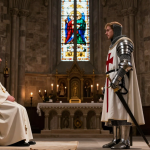
The Knights Templar, a medieval Christian military order, played a pivotal role in the history of the Holy Land during the Crusades. Founded in 1119, the order was established to protect Christian pilgrims traveling to Jerusalem and to defend the territories captured during the Crusades. Their influence extended far beyond military engagements; they became financial powerhouses and key players in the politics of the time. This article explores the Templars’ historical significance, their operations in the Holy Land, and their enduring legacy.
The Origins of the Knights Templar
The Knights Templar originated in the aftermath of the First Crusade, which culminated in the capture of Jerusalem in 1099. A group of nine knights, led by Hugues de Payens, formed the order with the primary aim of safeguarding pilgrims. Initially, they operated from the site of the Temple of Solomon, which contributed to their name. The order quickly gained recognition and support from the Church, receiving a papal endorsement in 1129 from Pope Honorius II. This endorsement allowed the Templars to establish a vast network of properties and resources across Europe and the Holy Land.
As the order grew, it adopted a monastic lifestyle combined with military duties. Templars took vows of poverty, chastity, and obedience, which distinguished them from other military orders. Their dual role as monks and soldiers was crucial for their operations in the Holy Land, where they needed to balance religious devotion with the harsh realities of warfare. This unique structure allowed them to attract members from noble families, further enhancing their political and military strength.
The Role of the Knights Templar in the Crusades
The Templars were instrumental in the Crusades, particularly during the Second and Third Crusades. They participated actively in numerous battles, including the pivotal Battle of Hattin in 1187, where they faced Saladin’s forces. Despite their valiant efforts, the Templars suffered a devastating defeat, leading to the loss of Jerusalem. This setback marked a significant turning point in the Crusades, highlighting the challenges faced by the Christian states in the Holy Land.
During the Third Crusade, led by Richard the Lionheart, the Templars continued to fight fiercely. Their military expertise and knowledge of the terrain made them invaluable allies. They established fortified castles and strongholds, such as the famous fortress of Montfort, which served as critical bases for Christian operations in the region. The Templars’ commitment to the defense of the Holy Land remained unwavering despite the changing tides of war.
The Templars’ Financial Power and Infrastructure
Beyond their military contributions, the Knights Templar developed a sophisticated financial system that revolutionized banking in medieval Europe. They established an extensive network of properties, farms, and castles, which generated significant income. This wealth allowed the order to fund military campaigns and support Christian pilgrims traveling to the Holy Land. They also developed an early form of banking, providing loans and safeguarding deposits for nobility and commoners alike.

The Templars created a system of credit that enabled pilgrims to travel safely without carrying large amounts of money. They issued letters of credit that could be redeemed at various locations, ensuring the safety of funds. This innovation not only facilitated commerce but also positioned the Templars as key players in the economic landscape of medieval Europe. Their financial acumen attracted both admiration and envy, contributing to their eventual downfall.
The Cultural and Religious Impact of the Knights Templar
The Knights Templar were also significant cultural figures in the Holy Land. They built numerous churches, monasteries, and fortifications, which contributed to the architectural landscape of the region. Their commitment to the Christian faith was evident in their efforts to promote pilgrimage and religious devotion. The Templars became symbols of chivalry and piety, embodying the ideals of Christian knighthood.
Moreover, the Templars played a role in the cultural exchange between East and West. Their presence in the Holy Land facilitated interactions with Muslim scholars and merchants, leading to a transfer of knowledge, trade, and ideas. This cultural exchange enriched both Christian and Islamic societies, although it was often overshadowed by the ongoing conflicts of the Crusades. The Templars’ influence in the Holy Land thus extended beyond military and financial realms, shaping the cultural dynamics of the period.
The Decline and Fall of the Knights Templar
The decline of the Knights Templar can be traced to a combination of political intrigue, financial mismanagement, and changing attitudes toward the Crusades. By the early 14th century, the Crusader states were weakening, and the Templars faced increasing scrutiny from European monarchs. King Philip IV of France, heavily indebted to the order, sought to dismantle their power. In 1307, he orchestrated a series of arrests against Templars, accusing them of heresy and other crimes.
The subsequent trials were marked by torture and forced confessions, leading to the dissolution of the order by Pope Clement V in 1312. Many Templars were executed, while others fled to different countries. The order’s vast wealth was confiscated, and their properties were redistributed to other military orders or the crown. This dramatic fall from grace marked the end of one of the most powerful institutions of the medieval era.
The Knights Templar’s Legacy and Modern Influence
Despite their dramatic decline, the legacy of the Knights Templar endures in various forms today. Their mythos has been romanticized in literature, film, and popular culture, often depicting them as guardians of sacred relics or secret knowledge. The search for the Holy Grail, often associated with the Templars, has become a popular theme in modern storytelling, blending history with legend.

Moreover, contemporary organizations claim to uphold the values and traditions of the Knights Templar. Various groups, including chivalric orders, continue to draw inspiration from the Templars’ ideals of charity, honor, and service. These modern iterations reflect the enduring fascination with the Templars and their historical significance in the context of Christian chivalry and the Crusades.
The Knights Templar and the Holy Land Today
Today, the Holy Land remains a focal point for many who study the Knights Templar. The historical sites associated with the order, such as the Temple Mount in Jerusalem and the ruins of Templar castles, attract scholars and tourists alike. Archaeological efforts continue to uncover evidence of Templar activities, contributing to our understanding of their role in the region’s history.
Furthermore, the ongoing conflicts in the Holy Land echo the Templars’ historical struggles. Their legacy serves as a reminder of the complexities of religious and cultural interactions in the region. As modern societies grapple with issues of faith, identity, and heritage, the story of the Knights Templar offers valuable insights into the enduring impact of medieval history on contemporary life.

I’ve always been fascinated by how societies and organizations shape history and everyday life. Writing about the interplay between cultural movements and institutional structures lets me explore the stories that connect past and present. I love digging into archives and sharing insights that help readers understand our collective journey.